
Reframing Legends
A guest post by Nicole Beauchamp, author Haunted French Quarter Hotels.
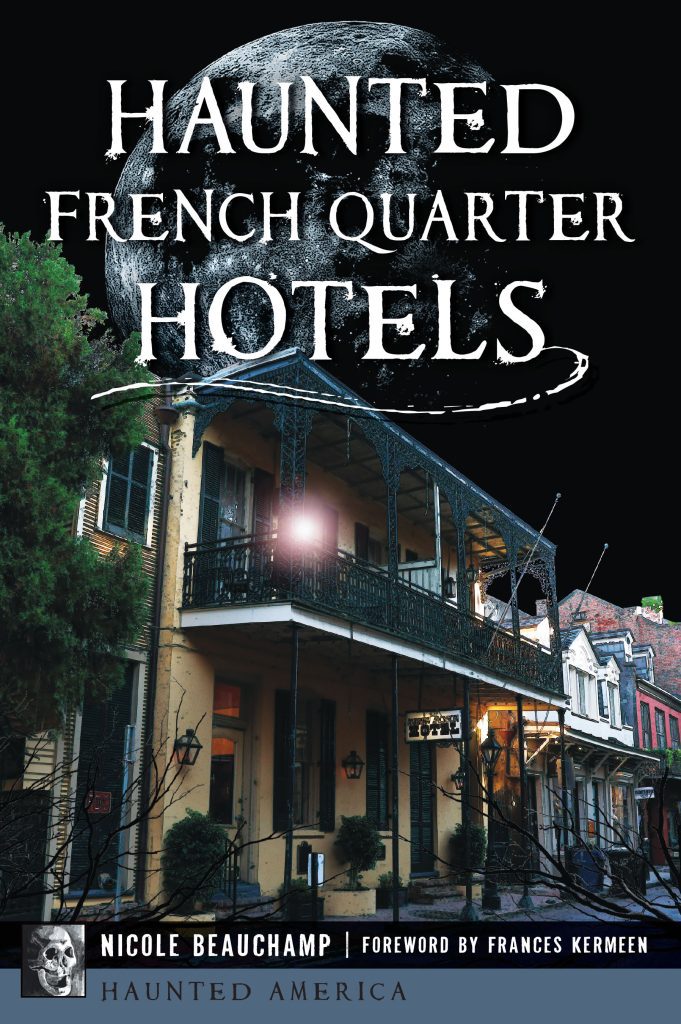
When I first set out to write Haunted French Quarter Hotels, I did not realize just how challenging the project would be. The city of New Orleans is 307 years old, and countless books, documentaries and productions have already explored not only its haunted past but also its history. I wanted so badly to offer something new, but I did not know how to do it. At the start of my project, I assumed there would be more than enough documentation to guide me in writing my book. Every property had websites with information, and numerous organizations had already published historical articles about New Orleans. I expected that between these sources I would be able to piece together what I needed without much difficulty. What I found instead was far more complicated. As I began my research, I quickly discovered that many of the city’s most beloved legends did not align neatly with the historical record.
I soon found myself navigating a space between folklore and fact. The legends are deeply cherished by both locals and visitors, and I never saw it as my role to dismiss them. These stories form part of the city’s cultural fabric. My goal was to honor them while also presenting the new insights that history and records could provide. I wanted readers to see that the legends still hold their place, but now they can be viewed with a fresh perspective, enriched by details that had not been uncovered before.
One example is the story of May Baily. At one point during my research, I questioned whether she was even real. Her name appears in folklore, tied to the French Quarter brothel that became the present-day May Baily’s Place, but details about her life were inconsistent. After connecting with genealogists and scouring police records, I confirmed not only her existence, but uncovered new dimensions of her life. The records revealed that she frequently altered her age, that she was often in trouble with police and that she spent her later years working as a street prostitute. Based on her documented age in these records, I am inclined to believe she was much older than she let on, which calls into question the claim that she was only 17 when she began running the brothel. When she obtained her brothel license, it seems far more likely that she was already a grown woman. Rather than erase the story, these findings complicate it and force us to reconsider what we thought we knew, while still acknowledging the enduring presence of her ghostly reputation.
The same process unfolded with the Andrew Jackson Hotel. Its official website claims the property once served as an orphanage for children orphaned by yellow fever, tragically destroyed by fire in 1774. But yellow fever epidemics in New Orleans did not begin until 1796, which means the date is not historically accurate. Even 1794 would have been too early for the epidemic to have inspired the founding of such an orphanage. Fires did ravage the French Quarter throughout the 18th century, and children likely did die in all of them, but the notion that they perished in an orphanage after their parents died of yellow fever does not align with this particular time frame—and such a need had not yet arisen in the city’s history. This demonstrates how easily a kernel of truth can evolve into a legend once retold over generations.
Throughout the project, I worked closely with organizations such as the Vieux Carré Commission, the Historic New Orleans Collection and Tulane University’s archives, among others, to ensure accuracy. The result is not a rejection of folklore but a reframing of it. Legends are preserved, but their foundations are clarified. Readers can still embrace the ghost stories while also seeing how the realities of immigration, poverty, disease and disaster shaped the city.
New Orleans is built on a legacy of resilience, tragedy and reinvention. Its legends are inseparable from that legacy, but pairing them with the historical record offers a new way to engage with the city. In presenting this material, I hope to honor both the folklore and the truth, allowing readers to reflect on how the past continues to shape the present and how ghost stories, when examined carefully, can teach us more about history than we might expect, all while preserving the very mysteries that make New Orleans irresistible.
Deep South readers are invited to a book release party with Beauchamp on Oct. 4 at The Haunted Hotel, 623 Ursulines Ave. in New Orleans, from 5-10 p.m. There will be psychic readings, photo opps, refreshments and a raffle to win the Ultimate New Orleans Experience. Beauchamp will also be at the Louisiana Book Festival in Baton Rouge on Nov. 1.
Nicole Beauchamp is a paranormal researcher, licensed massage therapist and the author of the recently-published Haunted French Quarter Hotels. The book ushers readers through the supernatural history of New Orleans’ French Quarter, making stops at the neighborhood’s 10 most haunted hotels. Learn more about Beauchamp on Instagram @authornicolebeauchamp.


