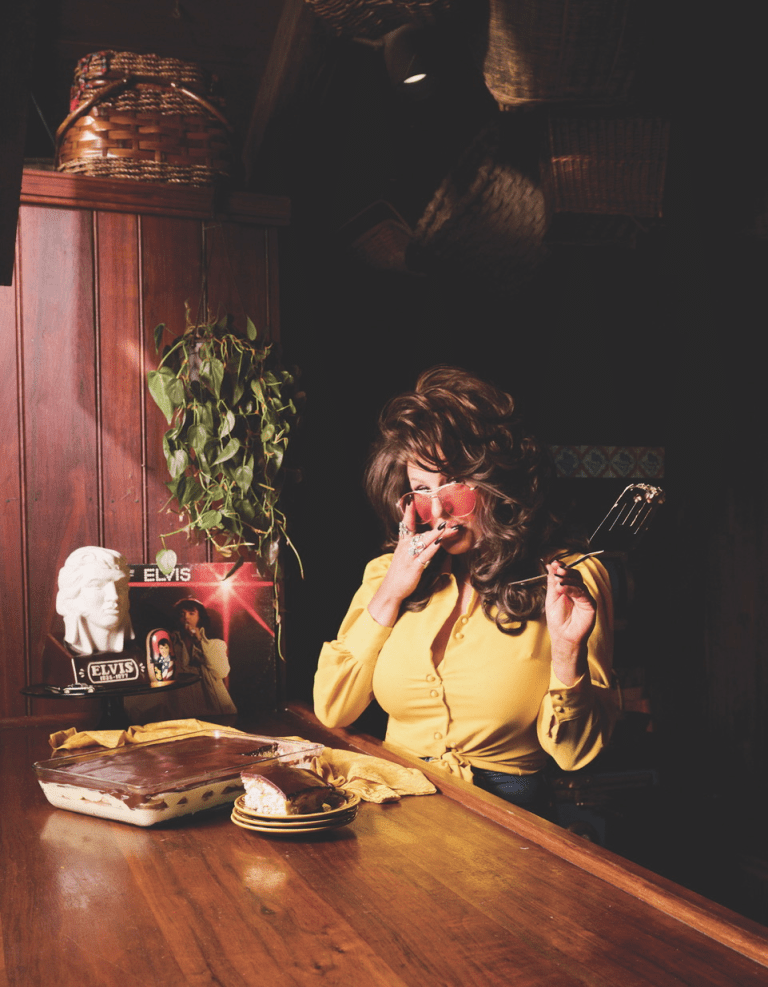
Rosie Grant’s To Die For: A Cookbook of Gravestone Recipes brings to life her popular “Ghostly Archive” project.

Growing up with parents who were both ghost tour guides, food folklorist Rosie Grant knew her way around a cemetery, but that doesn’t mean she was comfortable with death. “I think I hadn’t really thought much further than the average gravestone that had like ‘mother,’ ‘father’ or a spiritual quote,” she says.
It wasn’t until an internship at the Congressional Cemetery in Washington, D.C., in the early 2020s that she realized how personal headstones could get. “In Congressional, there are so many different types of gravestones and funny, very personal things that people had put onto their headstone,” she says. “It might be like one person worked for the Library of Congress and has the call number to their book on their headstone. Another person had their resume. Other people had poetry or funny quotes or movie references or things that were important to them in life. I just was so blown away by that.”
That gave her the idea that cemeteries didn’t have to be somber; they could be a celebration of someone instead.
She started her “Ghostly Archive” TikTok account as a graduate school project. She wasn’t sure there would be an audience for cemetery content, but “I was very wrong,” she says. “There’s a lot of people who just appreciate the art or they do preservation or do storytelling and history.” Her account turned into interesting gravestones in the D.C. area and then branched out from there.
She saw Naomi Odessa Miller-Dawson’s book-shaped gravestone recipe for spritz cookies on the internet, and “I was like, what does a cookie from a gravestone taste like?” she says. She baked the cookies with Naomi’s son Richard in his Brooklyn, New York, apartment for her book To Die For, and discovered that it was more about the ritual of pressing the dough through a cookie press and eating the cookies fresh out of the oven before they even left the tray than the taste.
Grant dedicates the book to her grandmothers, Catherine McCarthy and Rosemary Grant, who were both good cooks, just in different ways. Her grandmother McCarthy’s food was simple, and “she really liked breakfast,” Grant recalls. She and her cousins lived with her grandmother in the summer during college as she was transitioning to being a widow after her husband passed away, and they had breakfast with her every morning. Grant says she would put her grandmother’s breakfast menu on her grave: “Coffee, orange juice, eggs and toast.”
Her grandmother Grant is remembered for her maple walnut cake—made special for family birthdays.
Grant found the largest number of recipes in the Midwest, but the South has its share. “The New Orleans one was very exciting to visit, partially just because I can’t imagine a better city for food and death,” she says. The grave she visited there belongs to Natalee Pyatt, who volunteered at the Audubon Aquarium and loved animals. Natalee also loved doing things for people she loved, like planning surprise parties or sending them care packages.
Her gravestone recipe uses Betty Crocker Supreme Triple Chunk Brownie mix and adds extra chocolate morsels; white chocolate chips or Reese’s peanut butter chips can be substituted. She made the brownies for her friends and family, and her best friend Wendy told Grant she still had her friend’s final birthday gift of brownies in her freezer. Once a year on the anniversary of her death, Wendy eats one in memory of Natalee.
“I actually heard about this for several of the families, where in a couple of cases their family members were good at pickling and so they still have their canned pickles, which will probably not be eaten, but they are sitting on everyone’s shelves, which is really sweet, just like you can’t throw that away,” Grant says.
In Fort Myers, Florida, Julia Belle (J.B.) Kelley Pate grew guava in her yard and became known for her cobbler using the fruit. She made it once a week no matter the season, and her recipe was passed down for generations. With just five ingredients and simple instructions for baking on her gravestone, J.B.’s recipe illustrates an important point about these types of culinary homages.
Gravestone recipes can’t be too long, as space is limited. “None of the recipes were super complicated,” Grant says. “These are mostly home chefs. These are something treasured that they would make every holiday. So, there is a lot of nostalgia and family food history connected to each recipe.”
We’ve all tried to replicate a family recipe to no avail. Even if mom or grandmother has written it down for us, it’s going to taste different made by a different person. When trying to make the recipes she found, Grant did notice that there were some details missing. When she checked in with the families, they would tell her what was left out. “If you know, you know,” she says. “Part of my research was trying to make it to get closer to theirs.”
Her entire project has been crowdsourced, and the book contains 40 recipes—but Grant knows there are more out there. She even has a section about the importance of documenting your own family’s food history—whether it ends up on a gravestone or not.
“A culinary legacy is often taken for granted until it’s too late,” she writes. She suggests interviewing family members and asking questions like “What did you eat as a child” and “What foods do you associate with fond memories.”
Now that she’s much more comfortable with the concept of death, Grant has picked out her own plot in the Congressional Cemetery and knows which recipe she wants on her gravestone: clam pasta with handmade linguine in a white wine and garlic sauce. “My joy comes from the ritual of making it with others,” she writes. And that’s how she wants to be remembered when her time comes.
Find Grant’s Ghostly Archive on Instagram and TikTok, and get the book here.